Neuro-Symbolic Reasoning: Fundamentals, Models, Certification, and Systems#
V1.0 — Open English Manuscript
A Knowledge-Graph-Driven Framework for Trustworthy Governance in Urban Air Mobility and Safety-Critical AI
About This Book#
Yushu Liu | yushuliu@outlook.com | GitHub | Open-source Book
Modern AI excels at perception and generation but still struggles with explicit reasoning, rule compliance, uncertainty calibration, and certifiable deployment in safety-critical settings.
This book develops a complete technical stack for neuro-symbolic AI — not just one model trick, but a full pipeline:
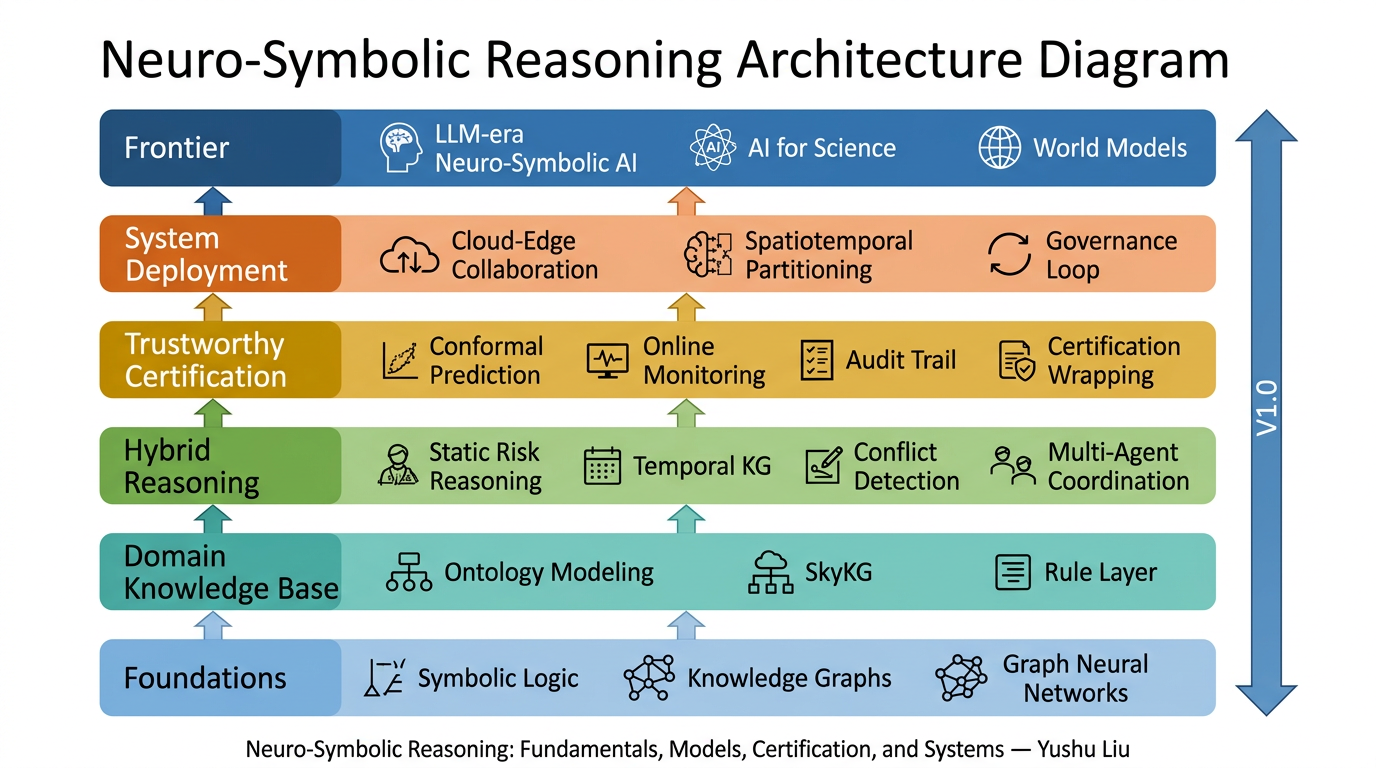
Knowledge Base → Hybrid Reasoning → Trustworthy Certification → System Deployment → Governance Loop
It covers 25 chapters across six layers, from symbolic logic and knowledge graphs all the way to cloud-edge deployment and LLM-era agents. Urban air mobility (UAM) is the primary scenario, but the methodology applies broadly to autonomous driving, medical AI, industrial control, and AI for Science.
What Makes This Book Different?#
Dimension |
Typical NeSy / Trustworthy AI Resources |
This Book |
|---|---|---|
Scope |
Single technique (e.g., logic + NN) |
Full stack: knowledge → reasoning → certification → deployment |
Trustworthiness |
Interpretability-focused |
Goes beyond to conformal prediction, online monitoring, certification wrapping, audit trails |
System view |
Model-centric |
Addresses compute gaps, cloud-edge collaboration, spatiotemporal partitioning, governance loops |
Application |
Abstract benchmarks |
Grounded in a real safety-critical domain (UAM) with generalizable patterns |
Openness |
Closed textbook or scattered papers |
Full open manuscript with runnable labs, knowledge graph, and structured reading paths |
In one sentence: This is the first open resource that traces the entire path from symbolic logic to certifiable, deployable neuro-symbolic systems, with a real safety-critical domain as its testbed.
How the Book Is Organized#
The book follows a deliberately layered architecture:
Foundations (Ch. 1–4) — Symbolic logic, knowledge graphs, graph neural networks, and deep representation learning
Domain Knowledge Base (Ch. 5–6) — Ontology modeling, SkyKG construction, and unified knowledge representation
Hybrid Reasoning (Ch. 7–13) — Neuro-symbolic taxonomy, knowledge injection, KG-driven reasoning, temporal graphs, conflict detection, and multi-agent coordination
Trustworthy Certification (Ch. 14–17) — Conformal prediction, online monitoring, drift detection, audit trails, and regulatory interfaces
System Deployment (Ch. 18–21) — Computing gaps, cloud-edge collaboration, spatiotemporal partitioning, and platformized governance loops
Frontier (Ch. 22–25) — LLM-era neuro-symbolic AI, safety-critical applications, AI for Science, and the future roadmap
Quick Start Guide#
If you want to… |
Start here |
|---|---|
Read the full introduction |
|
Browse the chapter map |
Neuro-Symbolic Reasoning: Fundamentals, Models, Certification, and Systems |
Get the fastest unique contribution overview |
Ch. 7, 10, 15, 21, 22, 25 |
Run hands-on Python experiments |
|
Understand the knowledge graph structure |
Citation#
If this work is useful to your research or teaching, please cite:
@book{liu2025neurosymbolic,
  title     = {Neuro-Symbolic Reasoning: Fundamentals, Models, Certification, and Systems},
  author    = {Liu, Yushu},
  year      = {2025},
  publisher = {GitHub open manuscript},
  url       = {https://github.com/liuyushugreat/Neuro-Symbolic-Reasoning-Fundamentals-Models-Certification-and-Systems}
}
License#
Book text, figures, diagrams: CC BY-NC-SA 4.0
Example code: MIT
Knowledge as the substrate · Reasoning as the core · Certification as the bridge · Deployment as the destination