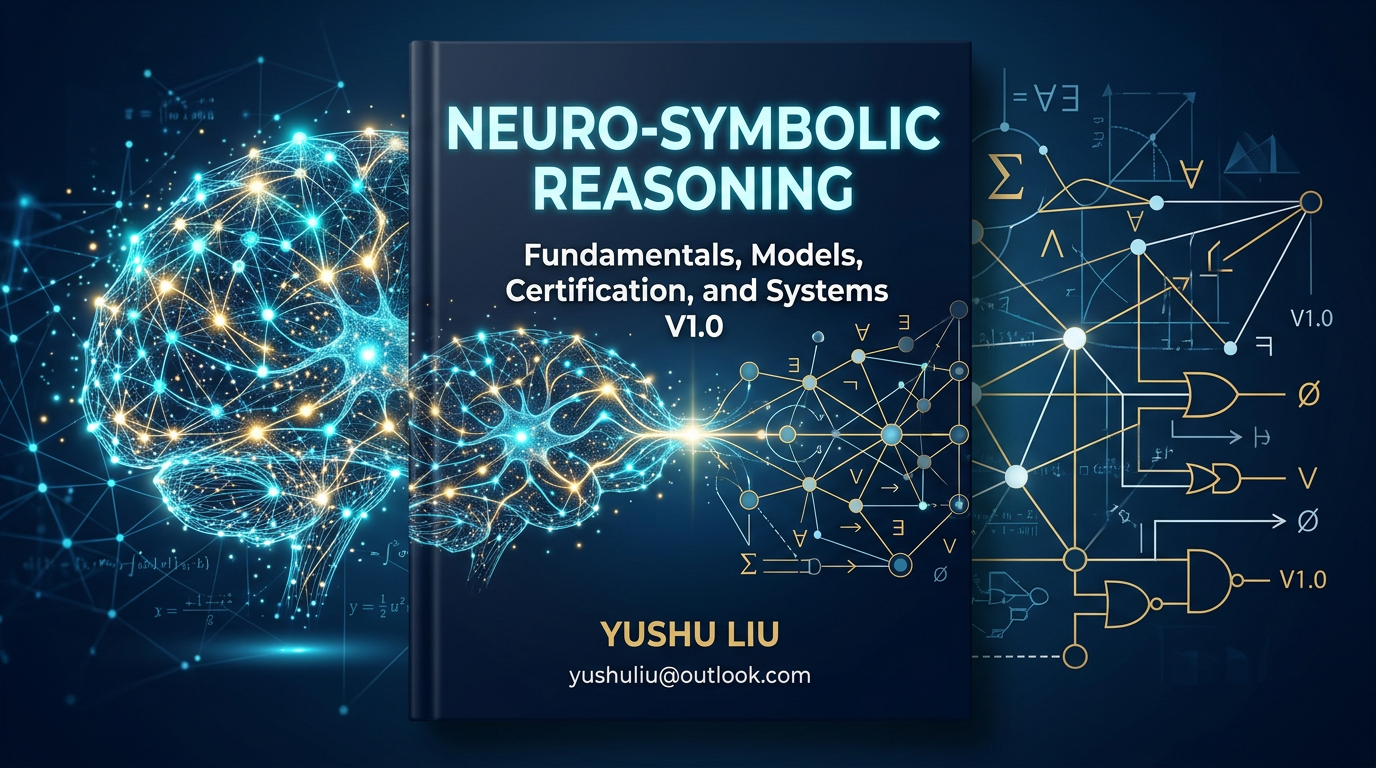
Neuro-Symbolic Reasoning: Fundamentals, Models, Certification, and Systems#
— Knowledge graph–driven neuro-symbolic reasoning and trustworthy governance in low-altitude traffic: theory and practice#
Scope of the book#
Core objective: Using “knowledge graph–driven neuro-symbolic reasoning and trustworthy governance” as the main line, this book explains the full technical chain of neuro-symbolic AI—from foundational theory and key models through certification mechanisms to system deployment—and takes urban low-altitude traffic / UAM as the primary scenario to develop a unified methodology that is interpretable, calibratable, deployable, and governable.
This book includes theoretical material related to the open-source project liuyushugreat/SkyNetUamPlatform.
Introduction: From the two-peaks dilemma in AI to the third path of neuro-symbolic AI#
Core objectives#
Clarify the historical tension between symbolic and connectionist AI; explain why neuro-symbolic AI has again become central in safety-critical complex systems; and introduce trustworthy governance of low-altitude traffic as the overarching problem of the book.
Chapter 1: The evolution, fracture, and reconstruction of AI#
1.1 The rise and fall of symbolic AI: from expert systems to the knowledge-engineering bottleneck
1.2 The rise of connectionism: deep learning’s success and the black-box crisis
1.3 The two-peaks dilemma: the long-standing split between strong perception and weak reasoning
1.4 Lessons from cognitive science: complementary mechanisms of System 1 and System 2
1.5 The proposal of neuro-symbolic AI: why unify perception, knowledge, reasoning, and decision-making
1.6 Special requirements in safety-critical settings: explanation, certification, robustness, real time
1.7 Low-altitude traffic / UAM: a representative challenge for neuro-symbolic AI
1.8 Main line and technical closed loop of this book: knowledge base—reasoning models—trustworthy certification—system deployment
Part I: Foundations—logic, representation, and learning#
Core objectives#
Equip readers from diverse backgrounds with foundations in logic, knowledge representation, deep learning, and graph learning, laying a shared base for later neuro-symbolic integration.
Chapter 2: Symbolic logic, rule systems, and automated reasoning#
2.1 Propositional logic and first-order predicate logic
2.2 Rules, constraints, and reasoning chains
2.3 Forward chaining, backward chaining, and resolution
2.4 Description logic and ontology languages: foundations
2.5 Uncertain logic and fuzzy logic: an introduction
2.6 From formal logic to engineering rule systems
Chapter 3: Knowledge graphs and domain knowledge representation#
3.1 Basic concepts of knowledge graphs: entities, relations, attributes, events
3.2 RDF, OWL, SPARQL, and graph query languages
3.3 Ontology construction: concept layer, relation layer, constraint layer
3.4 Event graphs, scene graphs, and temporal knowledge graphs
3.5 From multi-source heterogeneous data to unified knowledge representation
3.6 Knowledge graph updating, alignment, and consistency maintenance
3.7 From general KGs to domain-specific KGs
Chapter 4: Deep learning, graph learning, and neural representation#
4.1 Basic ideas of deep representation learning
4.2 Inductive biases of neural networks and function approximation
4.3 Graph neural networks: message passing, relational modeling, graph representation
4.4 Transformer and attention mechanisms
4.5 Temporal modeling and learning dynamical systems
4.6 Limits of deep learning: OOD behavior, hallucination, catastrophic forgetting, fragility
4.7 From deep models to constrained learning
Part II: A unified knowledge base—domain modeling for low-altitude traffic#
Core objectives#
Make explicit a pivotal chapter derived from the author’s dissertation work (Chapter 3): build the shared knowledge base for all subsequent models.
Chapter 5: Domain knowledge modeling for trustworthy governance in low-altitude traffic#
5.1 Object system for low-altitude traffic / UAM: aircraft, airspace, missions, infrastructure, stakeholders
5.2 Modeling risk objects: conflict, violation, failure, environmental disturbance
5.3 Modeling rule objects: regulations, operational constraints, priority rules, safety boundaries
5.4 Spatiotemporal objects: routes, corridors, windows, dynamic occupancy
5.5 Scene semantic templates: logistics, inspection, emergency, air taxi
5.6 Risk labels and design of explanation units
5.7 From business language to knowledge language: unified semantic abstraction
Chapter 6: Low-altitude traffic knowledge graph construction and unified representation#
6.1 Ontology layering: concept layer, instance layer, rule layer
6.2 Entity–relation patterns and attribute modeling
6.3 Unified expression of static knowledge, dynamic state, and certification objects
6.4 Encoding rule constraints: logical rules, soft constraints, conflict resolution
6.5 Graph construction pipeline: acquisition, cleaning, mapping, fusion, updating
6.6 Multi-source data ingestion: telemetry, maps, weather, policy, and operation logs
6.7 How the unified knowledge base supports subsequent models
Chapter 7: Taxonomy and technology roadmap for neuro-symbolic systems#
7.1 Classical taxonomy: Henry Kautz’s neuro-symbolic spectrum
7.2 A three-layer integration taxonomy: symbolic-dominant / hybrid-pipeline / deeply fused
7.3 Layer 1: rule-dominant knowledge-augmented systems
7.4 Layer 2: hybrid pipelines with KG + retrieval augmentation + language models
7.5 Layer 3: deeply fused models running directly on KG / TKG
7.6 Comparing the three paths: interpretability, real time, scalability, certification readiness
7.7 Main technical line of the book and chapter mapping
Part III: Static cognition—knowledge graph–driven interpretable risk reasoning#
Core objectives#
Explain how to build static interpretable reasoning frameworks with KG + RAG + LLM in settings that are rule-heavy, knowledge-dense, and demand very high interpretability.
Chapter 8: Basic paradigms of knowledge injection and constrained learning#
8.1 Loss-function formulations of logical rules
8.2 Constrained optimization and posterior regularization
8.3 Co-training of rules and neural models
8.4 Physical and mechanistic constraint networks
8.5 From knowledge injection to interpretable reasoning
Chapter 9: Hybrid neuro-symbolic reasoning driven by knowledge graphs#
9.1 SPARQL queries and deterministic evidence extraction
9.2 Semantic completion by LLMs and chain-style explanation generation
9.3 Applicability and limits of RAG in rule-dense scenarios
9.4 GraphRAG: from document retrieval to graph retrieval
9.5 Coupling external solvers with language models
9.6 From “being able to answer” to “answering with evidence”
Chapter 10: Designing interpretable risk reasoning frameworks—from SkyKG to a general methodology#
10.1 Problem definition for static risk reasoning
10.2 Coordinated organization of ontology + rules + retrieval indexes
10.3 Dual-channel reasoning: rule-query channel and semantic generation channel
10.4 Risk label outputs and explanation-chain generation
10.5 Faithfulness evaluation: rule alignment, unsupported-claim rate, evidence coverage
10.6 Strengths and boundaries of static single-body scenarios
10.7 Why move from static cognition to dynamic coordination
Part IV: Dynamic coordination—temporal knowledge graphs and multi-agent real-time reasoning#
Core objectives#
Focus on high-density, strongly time-varying, multi-agent interaction; explain how temporal KGs and graph neural networks support real-time conflict detection and coordinated de-confliction.
Chapter 11: Temporal knowledge graphs and dynamic relational reasoning#
11.1 From static KG to temporal KG
11.2 Representing time, events, and state transitions
11.3 Dynamic relations and time-varying edge weights
11.4 Temporal logic and continuous-time modeling
11.5 Event-driven reasoning and dynamic updates
11.6 Applicability of dynamic graphs in traffic and flight systems
Chapter 12: Graph-driven multi-agent conflict detection models#
12.1 Formalizing multi-UAV dynamic coordination
12.2 Graph attention and relation-aware message passing
12.3 Temporal encoding and stale-edge discounting
12.4 Spatiotemporally coupled conflict prediction
12.5 Real-time metrics: latency, throughput, stability
12.6 Accuracy metrics: CDR, FAR, F1, and warning lead time
12.7 From prediction to intervention: dynamic risk scores and priority ranking
Chapter 13: Coordinated de-confliction and decision-making on temporal relational graphs#
13.1 Relationship between conflict detection and conflict resolution
13.2 Generating avoidance strategies from paths and graph structure
13.3 Role of reinforcement learning in graph-path reasoning
13.4 Constraint-based coordinated de-confliction
13.5 Local optimality vs. global safety envelopes
13.6 From SkyFlow to a general dynamic reasoning framework
Part V: Trustworthy certification—calibratable, provable, auditable neuro-symbolic reasoning#
Core objectives#
Move “trustworthy AI” from loose discussion toward certification-grade trustworthy reasoning—the most dissertation-distinctive part of the book.
Chapter 14: Trustworthiness issues in neuro-symbolic systems#
14.1 Why neuro-symbolic systems are still not inherently trustworthy
14.2 Interpretability ≠ certifiability
14.3 Black-box confidence and overconfidence
14.4 Distribution shift, concept drift, and scenario transfer
14.5 Special trustworthiness requirements in safety-critical systems
14.6 From empirical performance to formal assurance
Chapter 15: Conformal prediction and uncertainty calibration#
15.1 Types of uncertainty: epistemic vs. aleatoric
15.2 Why probabilistic outputs are not the same as trustworthy confidence
15.3 Basic principles of conformal prediction
15.4 Conformal methods in classification, regression, and set prediction
15.5 Conformal calibration for graph and temporal models
15.6 Conformal scoring design for neuro-symbolic outputs
15.7 Risk prediction intervals and coverage guarantees
Chapter 16: Online monitoring, distribution shift, and statistical certification#
16.1 Failure modes in online inference
16.2 Martingale methods and sequential consistency monitoring
16.3 Concept drift and anomalous-distribution detection
16.4 Trust scoring for static explanation chains
16.5 Certification wrapping for dynamic conflict prediction
16.6 From “interpretable output” to “certification-grade output”
16.7 SkyCert: systematic design of a certification bridge
Chapter 17: Interpretability evaluation, audit chains, and regulatory interfaces#
17.1 Layers of interpretability: local, rule-based, causal
17.2 Evaluating faithfulness, sufficiency, and comprehensibility
17.3 Audit log design for neuro-symbolic systems
17.4 How human supervisors use explanations and certificates
17.5 Interface issues with aviation / autonomous-driving safety standards
17.6 From model trustworthiness to governance trustworthiness
Part VI: System foundations—city-scale cloud–edge neuro-symbolic reasoning architecture#
Core objectives#
Corresponding to SkyGrid: land all prior algorithms in city-scale systems engineering.
Chapter 18: Complexity of neuro-symbolic reasoning and the compute gap#
18.1 Sources of complexity in symbolic, graph, and large-model reasoning
18.2 Latency constraints of real-time systems
18.3 Concurrency pressure in city-scale low-altitude traffic
18.4 From algorithmic optimality to deployable utility
18.5 Necessity of layered deployment of the reasoning stack
Chapter 19: Distributed reasoning systems under cloud–edge collaboration#
19.1 Division of roles between edge and cloud reasoning
19.2 Distributed orchestration of rule checking, GNN inference, and LLM inference
19.3 Streaming data ingestion and event-driven scheduling
19.4 Knowledge sync, model sync, and state consistency
19.5 Real-time alerting chains and closed-loop response
19.6 From single-node feasibility to multi-node scale-out
Chapter 20: Spatiotemporal graph partitioning and high-concurrency reasoning engines#
20.1 Spatiotemporal graph partitioning
20.2 Subgraph cuts, boundary coordination, and cross-region conflict propagation
20.3 Parallelism mechanisms in graph reasoning engines
20.4 Load balancing for large-scale conflict detection
20.5 Throughput and fault tolerance for city-scale thousand-UAV scenarios
20.6 SkyGrid: from research prototype to engineering base
Chapter 21: Platform realization—from stacking models to governance closed loops#
21.1 Integrating knowledge base—reasoning models—certification—deployment architecture
21.2 Modular design for platforms
21.3 Unifying data flow, control flow, and evidence flow
21.4 Multi-role interfaces for regulators, operators, and executors
21.5 From research systems to industry application platforms
21.6 Open-source ecosystems and reproducible experiments
Part VII: Frontiers—large models, agents, and AI for Science#
Core objectives#
Keep the textbook forward-looking without leaving the main line—extensions beyond the core thread.
Chapter 22: Neuro-symbolic AI in the large language model era#
22.1 LLMs as System 1: strengths, hallucination, structural limitations
22.2 Coupling language models with symbolic rules
22.3 GraphRAG and knowledge-augmented reasoning
22.4 LLMs calling external solvers and toolchains
22.5 Neuro-symbolic agents: perceive—retrieve—reason—act
22.6 Agent coordination for complex governance systems
Chapter 23: Safety-critical industry applications#
23.1 Intelligent transportation and autonomous driving: scene-graph understanding
23.2 Urban low-altitude traffic: risk assessment and dynamic coordination
23.3 Interpretable reasoning stacks in medical diagnosis
23.4 Industrial control and fault diagnosis in complex systems
23.5 From “usable” to “deployable with confidence”: key differences
Chapter 24: Neuro-symbolic reasoning in AI for Science#
24.1 Molecular graphs, scientific knowledge, and interpretable discovery
24.2 Physical constraints and scientific mechanism learning
24.3 Knowledge-augmented simulation in complex systems
24.4 Prospects for neuro-symbolic methods in cross-disciplinary science
24.5 Feedback from industry applications to foundational theory
Closing: Summary and future research roadmap#
Chapter 25: The future of neuro-symbolic reasoning—from interpretability toward certification, governance, and deployment#
25.1 Summary of the main line: knowledge base, reasoning, certification, systems
25.2 Current bottlenecks: data, standards, benchmarks, certification, compute
25.3 Future direction I: unified world models and neuro-symbolic agents
25.4 Future direction II: certification-grade trustworthy AI
25.5 Future direction III: real-time governance of city-scale complex systems
25.6 Future direction IV: from UAM to broader safety-critical systems
Appendices and labs#
Appendix A: Mathematical, logical, and graph-learning notation#
A.1 Logical symbols and common rule templates
A.2 Notation for graph neural networks and temporal graph models
A.3 Conformal prediction and statistical calibration notation
A.4 System architecture and complexity-analysis notation
Appendix B: Common open-source libraries and engineering tools#
B.1 PyKEEN
B.2 DeepProbLog
B.3 Logic Tensor Networks (LTN)
B.4 PyTorch Geometric (PyG)
B.5 RDFLib / OWLReady2 / Neo4j / GraphDB
B.6 LLM + KG integration toolchains
B.7 Streaming inference and edge deployment frameworks
Appendix C: Course labs and practice projects#
Lab 1: Small low-altitude-traffic ontology construction and rule encoding
Lab 2: Static risk reasoning with KG + SPARQL + LLM
Lab 3: Conflict detection models on temporal knowledge graphs
Lab 4: Conformal prediction for risk outputs with confidence intervals
Lab 5: Prototype cloud–edge collaborative reasoning system
Lab 6: Joint agent development with large models + knowledge graph + solvers
For the English introduction and reading guide, see INTRODUCTION_EN.md.