Introduction#
About This Book#
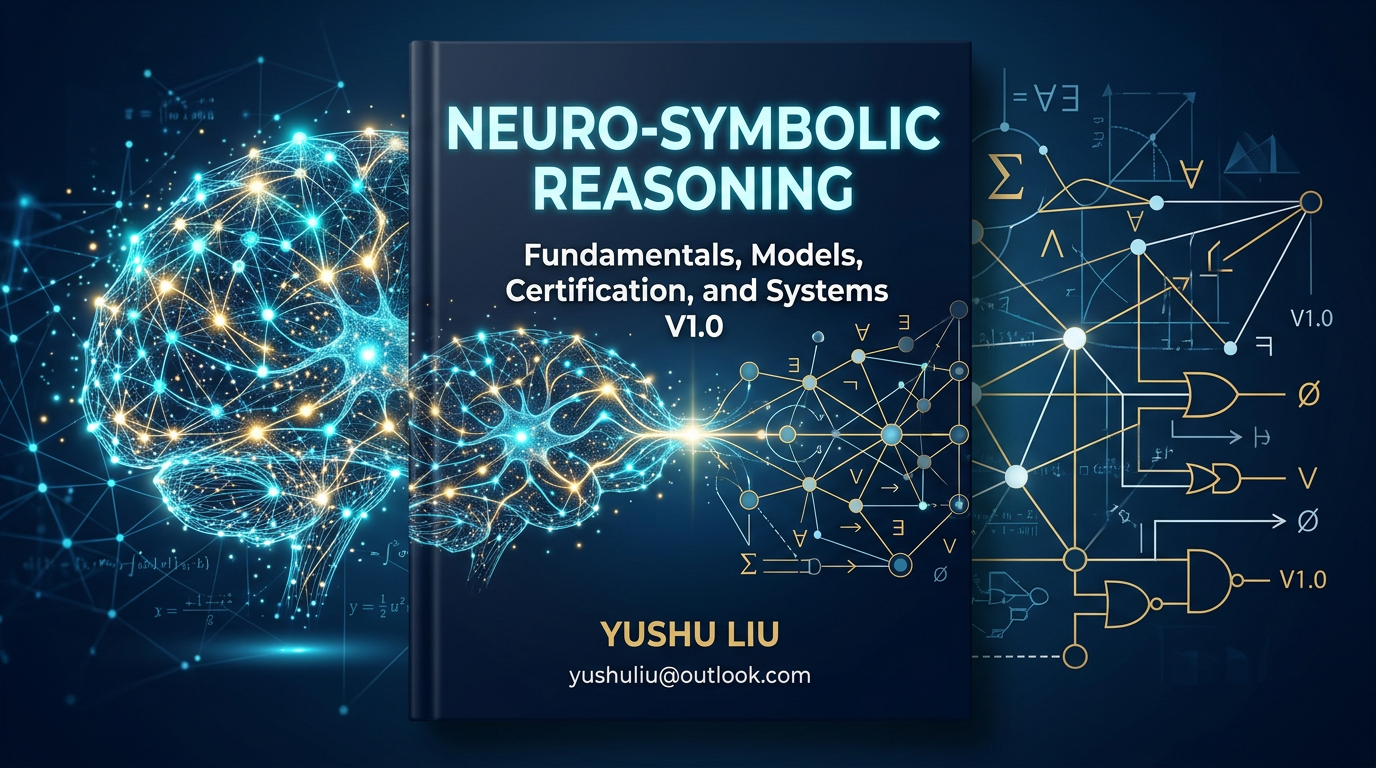
Neuro-Symbolic Reasoning: Fundamentals, Models, Certification, and Systems addresses a question that has become increasingly urgent in contemporary AI:
After deep learning has achieved major breakthroughs in perception, how can AI systems acquire explicit knowledge representation, rule-aware reasoning, trustworthy calibration, certification-oriented wrapping, and deployable governance loops, so that they can operate reliably in safety-critical and highly constrained real-world environments?
This book takes neuro-symbolic AI as its central thread. It does not treat symbolic reasoning and neural learning as two isolated traditions, nor does it reduce their combination to a simple “LLM plus a knowledge base” recipe. Instead, it organizes the field as a coherent technical stack spanning:
formal logic and structured knowledge representation,
domain ontologies and knowledge graphs,
graph learning and constrained neural modeling,
hybrid reasoning under rules and evidence,
temporal reasoning and multi-agent coordination,
uncertainty quantification and conformal prediction,
online monitoring, certification, and auditability,
and finally cloud-edge deployment and platformized governance.
While the main scenario of the book is urban air mobility (UAM) and low-altitude traffic governance, the goal is much broader. UAM is used as a high-pressure testbed because it naturally combines:
dense multi-agent interactions,
strong temporal dynamics,
explicit rules and constraints,
strict safety boundaries,
real-time decision demands,
and high requirements for explanation, accountability, and regulatory acceptance.
For this reason, it serves as an ideal domain in which to develop a general methodology for trustworthy, certifiable, and deployable AI systems.
Who This Book Is For#
This book is intended for several groups of readers:
1. Researchers in Neuro-Symbolic AI and Trustworthy AI#
If you are already familiar with deep learning, language models, graph learning, or knowledge graphs, but want to understand how to move from high-performing models to reasoning systems with explicit structure and guarantees, this book is written for you.
2. Engineers Building Knowledge-Driven Intelligent Systems#
If you work on knowledge graphs, rule engines, decision intelligence, or system integration, the book offers a structured route for connecting:
symbolic knowledge,
neural models,
calibration mechanisms,
and deployable engineering workflows.
3. Researchers and Practitioners in Safety-Critical Domains#
For autonomous driving, medical AI, industrial control, low-altitude traffic, and similar settings, good average performance is not enough. Systems must also be:
interpretable,
bounded by rules,
calibrated under uncertainty,
auditable,
and certifiable for deployment.
The later parts of this book are particularly designed for this audience.
4. Graduate Students and Advanced Undergraduate Students#
The book may also serve as a course companion, a structured reading guide for thesis work, or a cross-disciplinary entry point into:
symbolic logic,
knowledge graphs,
graph learning,
trustworthy AI,
certification and governance,
and neuro-symbolic systems engineering.
How to Read This Book#
This book can be read in two complementary ways.
A. Sequential Reading#
If you want a complete and systematic understanding, read from the beginning:
The opening chapters explain why neuro-symbolic AI matters.
The foundations chapters establish a common language in logic, knowledge representation, and graph learning.
The middle chapters build a domain knowledge base and show how to perform static and dynamic reasoning on top of it.
The trustworthiness chapters add calibration, certification, and auditability.
The systems chapters move from models to deployment, platformization, and governance loops.
The final chapters discuss LLMs, agents, AI for Science, and future directions.
B. Thematic Reading#
If your interest is more focused, you may jump directly to one of the following paths:
Logic and knowledge representation: Chapters 2–3
Graph learning and neural representation: Chapter 4 and Chapter 12
Knowledge injection and hybrid reasoning: Chapters 8–10
Temporal reasoning and multi-agent coordination: Chapters 11–13
Calibration, monitoring, and certification: Chapters 14–17
Systems and deployment: Chapters 18–21
LLMs, agents, and frontier applications: Chapters 22–25
How the Book Is Organized#
The architecture of the book follows a deliberately layered logic:
Layer 1: Why Neuro-Symbolic Reasoning?#
The early chapters revisit the long-standing divide between symbolism and connectionism, and explain why modern AI increasingly needs a third route that combines explicit reasoning with learned representation.
Layer 2: How Is Knowledge Structured?#
The next group of chapters provides the foundation in:
propositional and first-order logic,
rule systems and automated reasoning,
ontologies and knowledge graphs,
deep representation learning and graph neural networks.
This is the conceptual substrate for everything that follows.
Layer 3: How Is Reasoning Performed?#
The book then moves from representation to reasoning:
static explainable reasoning over knowledge-rich domains,
hybrid reasoning combining structured retrieval and language generation,
temporal knowledge graphs for dynamic interactions,
conflict detection and cooperative deconfliction among multiple agents.
Layer 4: How Can Outputs Be Trusted?#
One of the key claims of this book is that interpretability alone is not enough. We need certification-oriented trustworthiness. This includes:
uncertainty calibration,
conformal prediction,
monitoring of drift and abnormal distributions,
semantic audit trails,
and governance interfaces aligned with high-stakes deployment.
Layer 5: How Can the System Be Deployed?#
A method is not complete if it works only on paper. The book therefore addresses:
the compute gap between theory and deployment,
cloud-edge collaboration,
spatiotemporal graph partitioning,
concurrency and fault tolerance,
and platformized governance loops for large-scale intelligent systems.
Layer 6: Where Does the Field Go Next?#
The final part extends the discussion toward:
LLM-era neuro-symbolic AI,
tool-using and rule-bounded agents,
AI for Science,
world models,
and the long-term route from explainable AI to certifiable, governable, and deployable AI.
Companion Materials#
This English edition is intended to function not only as a manuscript but also as an open research resource. Companion materials include:
a structured table of contents,
appendices with notation and engineering tools,
runnable Python lab examples,
and a knowledge-graph-oriented reading map.
Final Remark#
If the last decade of AI has been largely about whether machines can see, predict, and generate, then the next phase will be about whether machines can:
represent knowledge explicitly,
reason under constraints,
quantify uncertainty honestly,
explain decisions structurally,
and operate responsibly in the real world.
This book is written as a contribution to that next phase.